


Most people are carrying something right now. The world feels unstable in ways that are difficult to name precisely, and beneath the larger churn there is often something more personal: work that has stalled, financial pressure that will not let up, a relationship absorbing more strain than either person wants to admit, or a quiet question about whether something we once believed about our future is still true.
Over the past several weeks, I have been writing about the human capacity a different future will require. But capacity is not tested only when we are building something new. It is also tested during the long periods when we can see trouble gathering, feel unable to stop it, and wonder whether our efforts matter.
Before the Finest Hour
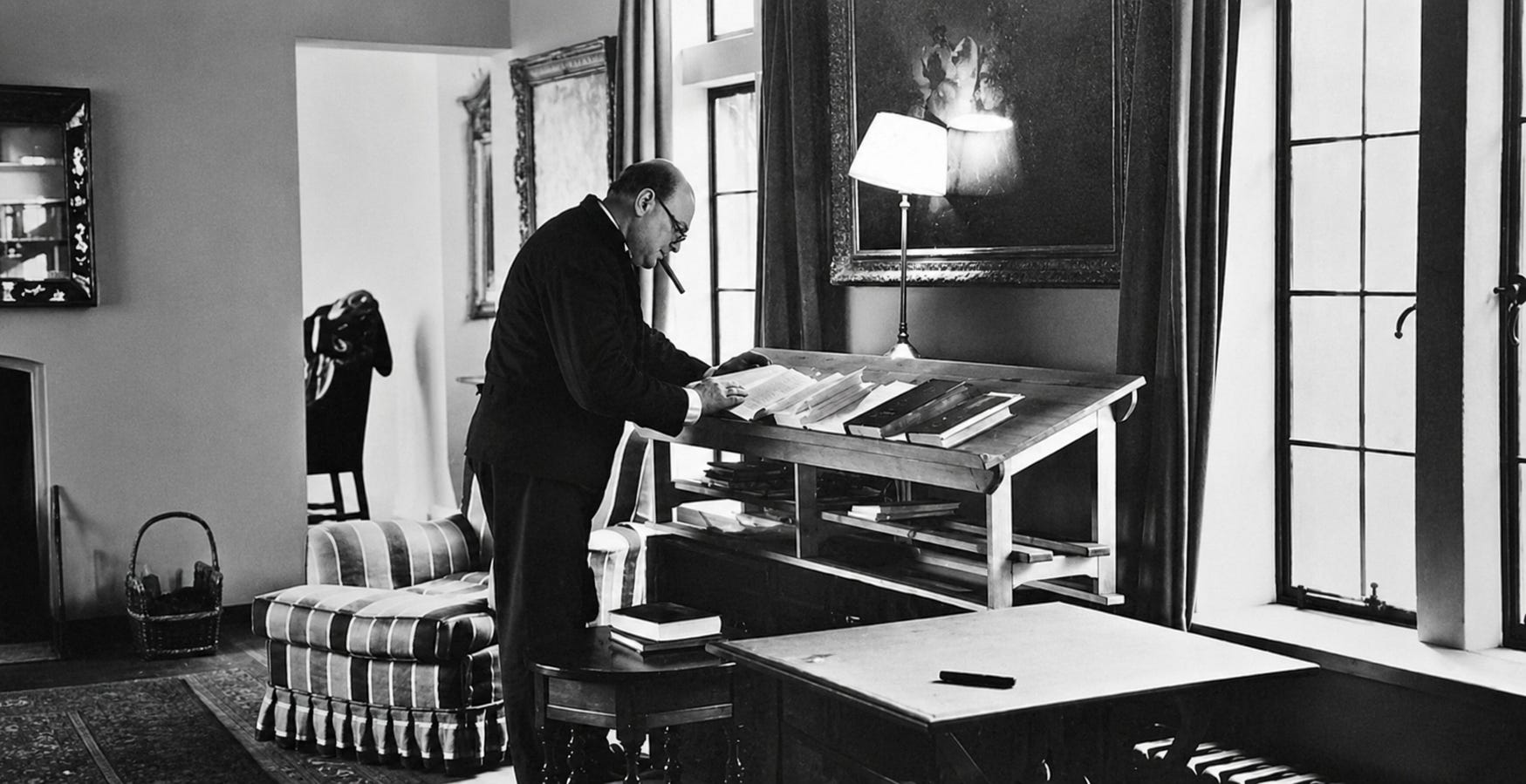
Most people remember Winston Churchill standing before a nation during its darkest hour. Fewer remember the years before that moment, when he was politically isolated, financially strained, depressed, and widely dismissed.
This week’s AMP film, The Gathering Storm, finds him in those wilderness years. He is watching the danger of Nazi Germany grow while much of his country would rather believe the threat could be managed or avoided. At the same time, his own life is under pressure. His finances are precarious. His influence has diminished. The depression he called his “black dog” continues to visit. His marriage carries some of the weight of his consuming work and volatile nature.
The external storm and the internal storm are not separate. Anyone can recognize danger from a position of comfort. Churchill was trying to remain discerning while his own life felt as though it might be coming apart.
The AMP session moves through that full experience: the fear of losing the house and family, not knowing how the bills will be paid, feeling that no one takes you seriously anymore, and wondering whether the mission has failed and it is time to stop. It also examines the anger, self-importance, jealousy, demanding behavior, and urge to force others to see what he saw.
That complexity matters. Seeing a threat early does not automatically make someone wise. It can deepen discernment, but it can also intensify fear, ego, isolation, and the need to be proven right. The challenge is not only to recognize what is gathering around us, but to notice what that recognition begins to awaken within us.
What Seeing Early Can Do to Us
When other people do not see what we see, it is easy to become frightened, bitter, or self-righteous. We may begin to treat disagreement as blindness and resistance as betrayal. We can become so determined to awaken others that we start trying to control them.
Churchill’s strength was real, but so were his ego and forcefulness. This session does not ask us to imitate him or turn him into a flawless hero. It lets us examine the entire pattern: courage and fear, discernment and worry, leadership and domination, conviction and the desire to be proven right.
That may be the deeper purpose of this AMP session. It is not primarily asking us to predict the storm correctly. It is asking us to notice what uncertainty, dismissal, and powerlessness awaken inside us.
Can we acknowledge fear without letting it govern us?
Can we remain informed without becoming consumed by alarm?
Can we keep speaking truthfully without demanding that everyone agree with us?
Can we continue caring for the people around us when the work we believe in has absorbed nearly all our attention?
Those are difficult questions because the wilderness does not provide quick answers.
The Cost of Continuing
I know something about spending years committed to work that other people do not yet fully see. The hardest part is not simply the lack of recognition. It is the financial pressure, the strain it places on the people you love, and the private question of whether continuing is courage or simply an inability to let go.
There is no clean answer to that question while you are living it. Persistence can be courageous, but it can also become rigid. A sense of mission can sustain us, but it can also cause us to neglect the life and people immediately around us. Being dismissed can sharpen our clarity, or it can leave us desperate for vindication.
The Gathering Storm session does not remove that tension. It moves through it. Churchill worries about money, his home, his family, and whether he still has the courage and energy to continue. He feels powerless and insignificant. He can also be bad-tempered, demanding, and difficult at home. Still, another part of him believes the work matters and refuses to retreat.
That is not a polished story of perseverance. It is the uncomfortable reality of trying to continue when certainty and emotional reserves are both running low.
Keep Buggering On
Churchill used the phrase “KBO,” meaning “Keep Buggering On.” It sounds inspirational when we already know how his story ends. But he did not know that history would call him back.
KBO was not confidence that everything would work out. It was what remained when he felt broke, dismissed, depressed, and unsure of his future. It was not always noble. Sometimes it was simply the decision to get through another day, return to the work, calm his nerves, take refuge in nature, or try not to disappear into the black dog.
The session holds both sides of that phrase. “If I give up now, then I will never know how big this could be” appears alongside “I just want to be done with all this” and “I don’t think I can handle another month of financial uncertainty.” It is not the language of certainty. It is the language of someone moving back and forth between belief and exhaustion.
Many people know that movement. One day the work feels essential. The next day it feels pointless. One day we can imagine a future. The next, we are trying to make it through the bills, the grief, the news, or the strain in our own home.
AMP does not require us to pretend we are fearless. One of the statements in this session suggests that recognizing and acknowledging fear can be a mark of wisdom. The work is to face what frightens us so it has less power over our choices, while also noticing when fear is making us more controlling, reactive, or isolated.
Churchill’s wilderness years eventually ended. Ours may not end in public recognition or a place in history. That cannot be the promise of this session. The more honest invitation is to keep attending to our clarity, our relationships, and our humanity while the outcome remains unknown.
Sometimes our work is not to control the storm or convince everyone that it is coming. It is to remain clear, prepared, and human enough to serve when the moment finally asks something of us.
This Session May Be for You If
There is change in your life unlike anything you have experienced before, and you feel immobilized by it.
You can feel something gathering around you but are unsure what to do with that awareness.
You are carrying financial pressure, stalled work, family strain, or uncertainty about your future.
You have stayed committed to something other people do not yet fully understand.
You are trying to remain clear without becoming fearful, bitter, controlling, or exhausted.
Before You Begin
AMP sessions are designed to be experienced in a particular order. Please begin with the AMP Intention Session before watching The Gathering Storm. The Intention Session helps you enter the process consciously and establish your willingness, boundaries, and pace.
This session explores fear, depression, financial uncertainty, relationship strain, power, and the emotional cost of continuing when the future is unclear. Move through it gently. You do not need to force a reaction or agree with every statement. Simply notice what resonates, pause when needed, and take care of yourself as you watch.
Begin with the AMP Intention Session
Continue with The Gathering Storm AMP Session
Watch the film in its entirety
About David
David Barnes is the co-creator of the Alignment Movie Process (AMP), a framework that uses film to help people recognize the emotional beliefs and patterns shaping their lives. His work explores emotional maturity, human sovereignty, AI, and how we might build systems that serve human life rather than simply becoming more powerful.
He writes about the patterns beneath our individual and collective choices, and what becomes possible when we move beyond reactivity toward greater awareness, responsibility and integrated wisdom.
To learn more about the Alignment Movie Process and explore how it works, visit AMP EXP.