


More than thirty years ago, on my first day working with one of Ford Motor Company’s largest dealerships, the general manager handed me a book by M. Scott Peck called A World Waiting to Be Born: Civility Rediscovered. It was not about selling cars, managing people, or increasing profits. It was about building community.
The dealership had embraced Peck’s ideas, and the results were remarkable. Sales were strong. Customer satisfaction was high. People genuinely cared about one another. It was one of the healthiest business cultures I had experienced.
But I also noticed something unexpected. As people became more open with one another, emotions surfaced that many had never learned how to navigate. The community was not causing those emotions. It was bringing long-standing patterns into view.
I found myself asking a question that has stayed with me for more than thirty years:
How do we learn to live well together without becoming trapped in the reactive patterns that keep pulling communities apart?
The Question That Wouldn’t Leave
Over the years, I explored many approaches to human development. I studied leadership, psychology, executive coaching, Eastern philosophy, the Yoga Sutras, and consciousness traditions. I trained with master yoga teachers and learned from thoughtful people who had devoted decades to their disciplines. Much of what I encountered expanded my understanding and changed my life.
Yet the same question remained. People became more aware. They opened their hearts. They saw things they could not see before. Then life happened. A marriage became strained. A business struggled. A child became ill. A parent died. Conflict surfaced at work. The patterns people had begun to recognize inevitably showed up in the relationships and communities that mattered most.
Awareness had arrived, but what were we supposed to do with our patterns when they showed themselves in reactivity?
I kept finding theories, teachings, and practices that helped people understand themselves more deeply. What seemed harder to find was an accessible way to help people work with what awareness revealed as they moved through ordinary life.
Why Structure Isn’t Enough
Last week I wrote that the next stone isn’t another institution. It’s human capacity.
That was not simply a statement about individual development. It was about collective capacity. When I first began imagining a different way of living together, I knew this question had to be addressed. Otherwise, whatever we created would eventually become another idealistic community overtaken by the same unresolved patterns its members carried into it.
We can create a new organization, political movement, intentional community, or social system. We can write better laws and design better technology. All of that matters. But if the people inside those structures have not learned how to recognize projection, recover from reactivity, tolerate difference, repair trust, and remain connected through disappointment, the new structure will slowly begin to resemble the old one.
That is why I believe no community can become healthier than the people who inhabit it.
A healthier structure can create better conditions. It cannot do the human work for the people living inside it.
Communities Reveal What We Carry
Community is difficult because closeness reveals us. Distance allows us to hide some of our fears, judgments, insecurities, resentments, control patterns, and unmet needs. When people begin living or working more openly together, those patterns become harder to avoid.
This is also why hopeful communities often struggle. The vision may be sincere. The values may be generous. The people may genuinely want something better. But goodwill alone does not teach us what to do when someone disappoints us, challenges our identity, triggers an old wound, or refuses to behave the way we think a member of the community should.
Without a practice, people often retreat, harden, blame, attack, leave, or attempt to control the people around them. Over time, the community begins organizing itself around those unresolved patterns rather than the purpose that originally brought everyone together.
That was the gap I kept seeing. The language changed depending on whether I was in a corporate, nonprofit, spiritual, therapeutic, or personal-development setting. The underlying problem did not.
People were being helped to see more. They were not always being given practical ways to live differently with what they saw.
I Wasn’t Searching for Another Philosophy
Looking back, I realize I was not searching for another theory of human development. I was searching for a practice.
I wanted something that could help people recognize what was happening beneath their reactions and gradually develop a steadier way of responding. Something they could use in ordinary life, not only when a teacher, coach, therapist, or group was available.
That search eventually became the Alignment Movie Process (AMP).
Stories give us enough distance to see human patterns without immediately defending ourselves. We can watch a character repeat a familiar groove, see the consequences, and sometimes recognize something about ourselves that would have been harder to hear through direct advice.
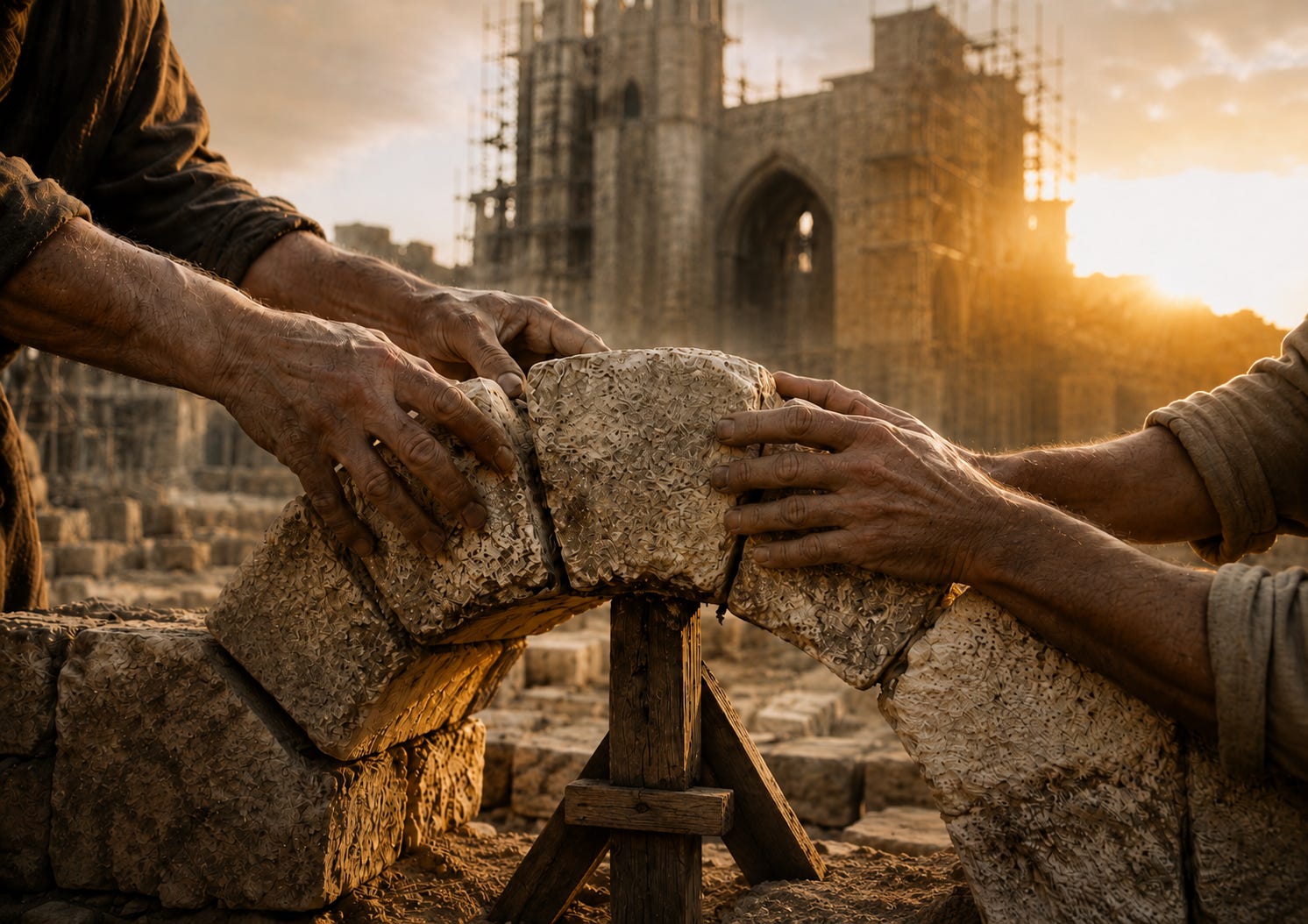
An AMP session does not build the whole cathedral. It offers one opportunity to shape and place the next stone.
Two AMP Sessions, Two Very Different Communities
The two films below are not simply recommendations or illustrations. Each has a corresponding Alignment Movie Process (AMP) session designed to help you recognize and work with the patterns the story may mirror in your own life.
Wanderlust is comic, messy, and hopeful. George and Linda leave behind a life that has collapsed and stumble into Elysium, an intentional community trying to live by different rules. The setting appears freer and more loving than the conventional world they left, but the inhabitants still carry ego, insecurity, judgment, fear, manipulation, sexual confusion, and control into the experiment.
The film asks a practical question: can we remain ourselves, tolerate difference, and learn from the people who irritate us without either surrendering our individuality or abandoning the community?
Malèna moves in the opposite direction. It shows an entire town projecting its jealousy, desire, shame, fear, and insecurity onto one woman. Gossip becomes accepted truth. Judgment becomes social permission. Eventually, ordinary people participate in humiliation and cruelty while convincing themselves that she deserves it.
The danger in Malèna is not one obviously evil person. It is the way a whole community stops examining what it is projecting and gives itself permission to dehumanize someone else.
One film shows an idealistic community struggling with the ordinary patterns its members bring with them. The other shows what can happen when a community refuses to recognize those patterns at all.
In both cases, what remains unresolved in individuals eventually becomes culture.
Which AMP Session Is Right for You This Week?
Start with the Wanderlust AMP Session if…
You are drawn to the idea of a more open, collaborative, or heart-centered way of living, but you also find yourself judging the people, language, lifestyles, or quirks that often accompany those spaces.
This session may be a useful starting point if you want more community but also need independence, become irritated by people who seem impractical or overly idealistic, fear losing yourself inside a group, or struggle with trust, intimacy, and shared responsibility.
Wanderlust is the lighter doorway. It reveals how quickly our desire for freedom, belonging, and a better way of living can collide with the judgments, fears, and control patterns we carry into the community with us.
Start with the Malèna AMP Session if…
You are carrying a deeper concern about judgment, exclusion, gossip, projection, scapegoating, or the way groups can turn against an individual.
This session may be useful if you have experienced rejection by a family, workplace, church, neighborhood, or community; if you are troubled by public humiliation and polarization; or if you want to examine the moments when you may unconsciously participate in a group’s judgment of someone else.
Malèna is the more demanding film. It reveals what can happen when fear and projection become more powerful than our shared humanity.
Before You Watch
If this is your first AMP film, complete the Intention Session before watching. It is used once and carries forward to future AMP sessions. The intention is not to force change, but to allow the film, the resonance statements, and your own awareness to work together in your own timing, with grace and ease.
Step One: The Intention Session
If this is your first AMP film, speak these statements aloud before watching. If you’ve already completed an Intention Session with another AMP film, it carries forward.
1. I allow the changes in my own timing and only integrate what I am ready for.
2. I have faith that I will receive the benefits I desire.
3. I am patient with myself as I make these changes.
4. I let go of feeling I am too busy to take the time for this.
5. I let go of needing to understand how AMP works and allow myself to receive what is right for me.
Then:
Nod your head yes.
Drink some water.
Take several slow, rhythmic breaths through your nose.
Then watch your AMP film all the way through.
Place Your Next Stone
Cathedrals were not built all at once. They were built because generation after generation showed up and placed another carefully shaped stone. Most of the builders never saw the finished structure, but their work made it possible for others to continue.
Collective capacity develops in much the same way. Humanity does not evolve because everyone changes overnight. Sustainable change happens as enough people gradually become steadier, less reactive, more discerning, and more capable of remaining connected through difference.
Last week’s post named human capacity as the next stone. This week’s AMP work offers a practical way to place one.
A healthier future will not be built only by passing better laws, electing better leaders, designing better institutions, or creating more powerful technology. It will also require people willing to recognize what they carry into every family, company, movement, and community they join.
That is the work no institution can do for us.
The next stone is ours to place.
About David
David Barnes is the co-creator of the Alignment Movie Process (AMP), a framework that uses film to help people recognize the emotional beliefs and patterns shaping their lives. His work explores emotional maturity, human sovereignty, AI, and how we might build systems that serve human life rather than simply becoming more powerful.
He writes about the patterns beneath our individual and collective choices, and what becomes possible when we move beyond reactivity toward greater awareness, responsibility and integrated wisdom.
To learn more about the Alignment Movie Process and explore how it works, visit AMP EXP.
People are tribal.