


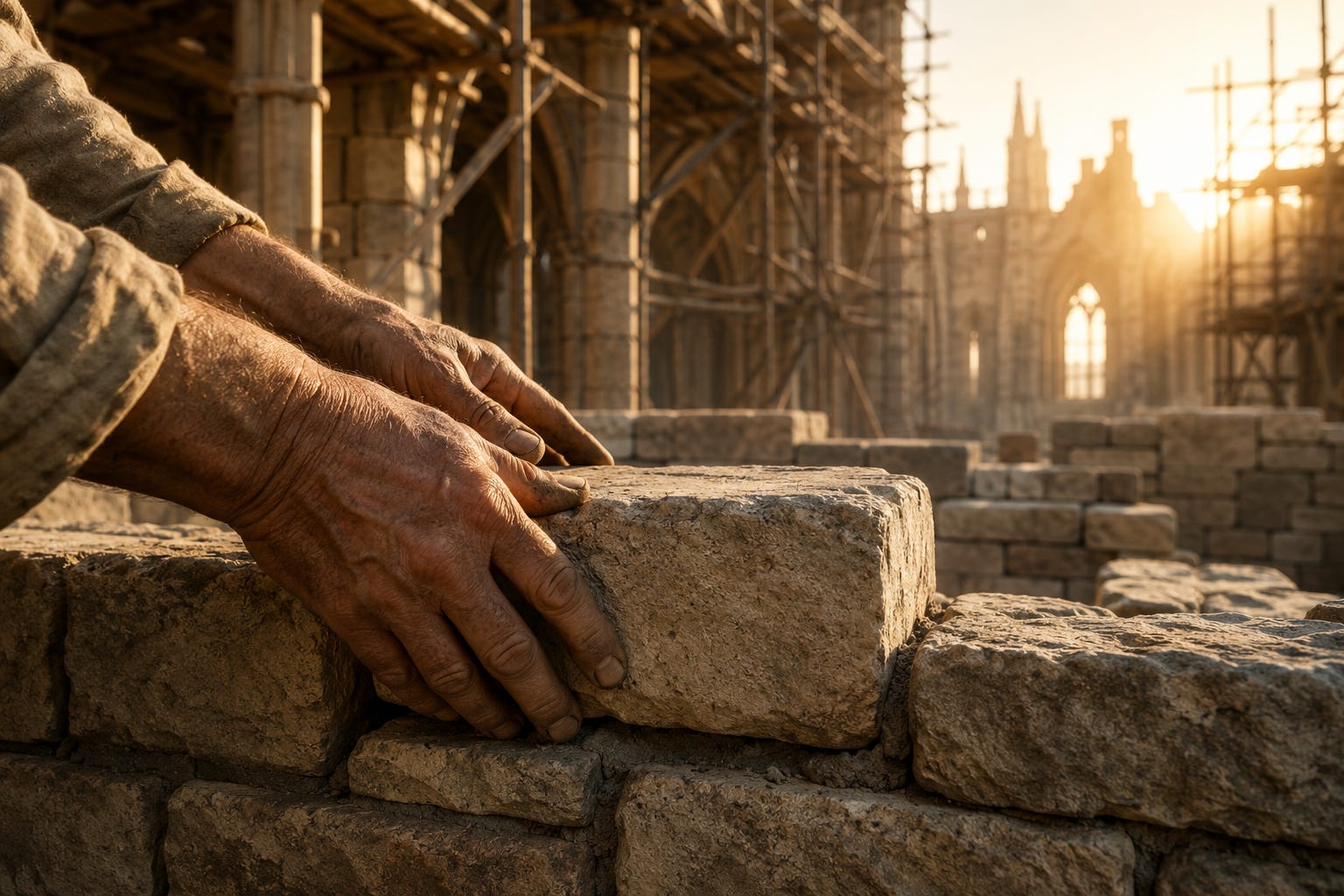
A cathedral is built by placing the next stone.
That thought has stayed with me ever since publishing the Declaration of Independence 2.0.
A declaration gives us something profoundly important. It gives us intent. It names the future we hope to create and points us toward a direction worth walking. History, however, teaches a humbling lesson. We have never lacked declarations, constitutions, mission statements, revolutions, or ambitious visions. What we have often lacked are the human capacities required to live inside them.
That realization quietly changed the direction of my life more than twenty years ago.
Working in both the corporate and nonprofit worlds, I kept seeing remarkably similar patterns. The organizational charts were different. The titles were different. The missions were different. Yet the same misunderstandings, fears, defensiveness, and struggles appeared over and over again. Eventually I realized something I couldn’t ignore.
No community can become healthier than the people who inhabit it.
Once I saw that, I realized the next stone wasn’t another institution. It wasn’t another political movement. It wasn’t another business model. It was human capacity itself.
Everything I’ve built over the last twenty years grew from that realization.
That question eventually became the foundation for the Alignment Movie Process (AMP). Long before artificial intelligence entered the public conversation, I believed we needed practical ways to help people recognize the emotional patterns quietly shaping their relationships, organizations, and communities. For most of those twenty years, I honestly didn’t know whether that vision could ever reach beyond one conversation, one client, or one community at a time.
Today, for the first time, I believe we are standing in a different moment.
AI Changes What May Be Possible
Most conversations about artificial intelligence ask what AI will become. Will it replace jobs? Will it outthink us? Will it become dangerous? Those questions matter. I find myself asking a different question.
What kind of humanity could AI make possible if we intentionally designed for it?
For centuries we have used technology to expand human capability. We have become remarkably good at producing more, calculating faster, communicating farther, and solving increasingly complex problems. The opportunity before us now is different. This may be the first technology that gives us an opportunity to intentionally expand human capacity: our ability to understand more, recover our balance more quickly, recognize our blind spots sooner, cooperate more wisely, and live together more intentionally.
I keep coming back to one sentence.
We’re asking AI to solve tomorrow’s problems while carrying yesterday’s emotional architecture.
That may be the defining challenge of the AI age.
Our systems often reflect our incentives more faithfully than our values. They represent our fears more consistently than our highest capacities. We continue hoping that a leader, a movement, a technology, or another metaphorical king will somehow rescue us from patterns we have not yet learned to recognize within ourselves.
The original Declaration of Independence declared freedom from a king. The Declaration of Independence 2.0 names something different. It names the patterns that quietly govern us long after kings are gone.
AI Is Not the Next King
AI is not the next king. It is another tool. The question is whether we use it to amplify yesterday’s patterns or tomorrow’s capacities. What if AI became more than another engine for productivity? What if we intentionally built AI to strengthen our capacity for wisdom, stewardship, balance, and cooperation? What if its greatest contribution wasn’t making us more efficient, but helping us see what we don’t yet see about ourselves?
That possibility is why I still haven’t given up on this work. Not because I believe AI will save us. Because, for the first time, I believe the conditions finally exist for the work of developing human capacity to reach far beyond what was previously possible.
The Cathedral We Are Building
Cathedrals were never built for a single generation. They were built to endure. Generation after generation placed another stone, knowing they might never see the finished work. They built something that would outlive them, inspire those who came after them, and quietly remind each generation that some things are worth giving your life to even if they take longer than one lifetime.
That is how I have come to understand this work. The Declaration was one stone. Human capacity is the next. The Alignment Movie Process is one attempt to help people recognize the patterns that quietly shape how they live, lead, love, and work together. AI is not the cathedral. AMP is not the cathedral.
The cathedral is a civilization that keeps developing the human capacity to place the next stone.
That is the opportunity before us. Not simply to build more intelligent machines, but to become wiser human beings in their presence.
A Practice to Go With the Idea
Ideas matter. Practice changes us.
If you’d like to explore this week’s idea more deeply, I’ve included the companion AMP session below.
AMP Session Note
Film: Outlaw King (2018)
Pattern: Old systems collapsing, freedom from domination, coalition building, courage, fear, vengeance, and the difficulty of building something new while still carrying the emotional habits of the old order.
This session surfaced because the pattern in the film mirrors the one I believe we’re living through today. People sense the old system no longer represents them, yet we still struggle to imagine the maturity, courage, and coalition required to build something better.
Why the Intention Session Matters
In AMP, the Intention Session is used once as a bridge. It invites the mind and body to allow resonance changes to unfold in your own timing, with grace and ease. The point is not to force a breakthrough, but to let the film, the statements, and your own reflection work together over time.
Step One: The Intention Session
If this is your first AMP film, speak these statements aloud before watching. If you’ve already completed an Intention Session with another AMP film, it carries forward.
1. I allow the changes in my own timing and only integrate what I am ready for.
2. I have faith that I will receive the benefits I desire.
3. I am patient with myself as I make these changes.
4. I let go of feeling I am too busy to take the time for this.
5. I let go of needing to understand how AMP works and allow myself to receive what is right for me.
Then:
* Nod your head yes.
* Drink some water.
* Take several slow, rhythmic breaths through your nose.
Then watch Outlaw King all the way through.
A Few Statements From the Session
* I let go of trying to drag old patterns into a new future.
* I allow myself to recognize when the old system no longer works.
* I let go of believing fear, vengeance, or domination can build freedom.
* I allow courage to be joined with balance, wisdom, and coalition.
* I let go of confusing movement fever with true collective purpose.
* I allow myself to help build something new without becoming what I am trying to move beyond.
About David
David Barnes is the co-creator of the Alignment Movie Process (AMP), a framework that uses film to help people recognize the emotional beliefs and patterns shaping their lives. His work explores emotional maturity, human sovereignty, AI, and how we might build systems that serve human life rather than simply becoming more powerful.
He writes about the patterns beneath our individual and collective choices, and what becomes possible when we move beyond reactivity toward greater awareness, responsibility and integrated wisdom.
To learn more about the Alignment Movie Process and explore how it works, visit AMP EXP.