



Earlier this month, Oprah devoted an episode of The Oprah Podcast to a blunt question: “We’ve Never Been Meaner. Here’s Why.”
It caught my attention because I had been wondering something similar. Why do so many of us seem more tense, more reactive, and more ready to fight?
Then this week I found myself talking about exactly that with a woman I have gotten to know at the Costco pharmacy. We had both noticed the same thing while driving: more speeding, more cutting people off, less willingness to let someone merge, a sharper edge to something as ordinary as getting across town.
At first, we wondered whether some of it was simply the relentless North Texas heat. I’ve started thinking of that as weather stress. We happened to be talking about Texas, but weather stress is hardly local anymore. Around the world, people are adapting to prolonged heat, floods, fires, storms, and other disruptions that place additional strain on bodies already absorbing uncertainty from everywhere else.
Weather stress may lower the threshold. But I don’t think it explains the whole thing.
What If Anger Isn’t the Beginning of the Story?
Look around and it is hard to miss how much change we are absorbing at the same time. Artificial intelligence is transforming work faster than many people can understand what it means for their future. Wars appear and expand. Relationships between countries we assumed were stable suddenly feel uncertain. Institutions we believed would endure are changing. Places people love are being altered while they watch. Economic pressures increasingly come wrapped in numbers so large that most of us can barely make sense of them.
Any one of these things might be manageable. The problem is that they are arriving together, and they do not seem to end.
Years ago, I worked with a board member whose company specialized in turning around failing businesses. He told me that when they entered a troubled company, they essentially had about six months to make the turnaround work.
I asked him why.
His answer stayed with me. People can tolerate extraordinary disruption for a while when they understand why it is happening, trust the people leading them through it, can see where they are going, and believe there is an end. Eventually, though, the disruption itself begins damaging the organization.
I experienced a version of that at Ford. I was transferred three times in five years. Each move made sense on its own. What became difficult was not knowing when the next one might come. At some point I realized I could not author a future inside a system that reserved the right to reorganize my life indefinitely.
That may be part of what many of us are experiencing now, only at a much larger scale. I’ve started calling it indefinite instability: not change, not even crisis, but the feeling that the ground keeps moving and nobody can tell you when it will stop.
Human beings can withstand an astonishing amount when we can make sense of it. But what happens when the restructuring keeps restructuring, when the emergency becomes the environment, when another disruption arrives before we have metabolized the last one?
Eventually, something important can begin to erode: our sense of agency, the feeling that we can meaningfully influence what happens next.
And when people lose agency, they do not necessarily become passive. Sometimes they become much more ready to fight, which brings me back to this week’s AMP session. Fight Club may be almost perfectly suited to these times.
Tyler Is the Illusion That the Fight Will Restore Agency
The unnamed narrator (Edward Norton) Fight Club is not initially an angry revolutionary. He is numb, disconnected, dissatisfied with work, and strangely detached from his own life. He has surrounded himself with things, but he cannot seem to feel much of anything.
Then Tyler Durden appears.
Tyler (Brad Pitt) is everything the narrator believes he is not: fearless, decisive, sexually alive, physically powerful, funny, certain, and free. He offers the narrator a way to feel again, first through pain, then through fighting, then through belonging, and eventually through a movement.
The original Fight Club AMP session contains the line:
“I fight other men so I can feel again.”
That may be one of the most important things the movie understands. Sometimes the fight is not really about the fight. Sometimes it is an attempt to recover something that feels lost: power, meaning, belonging, masculinity, certainty, agency.
Tyler is the illusion that the fight will restore agency.
The Hook Is Rarely Ugly
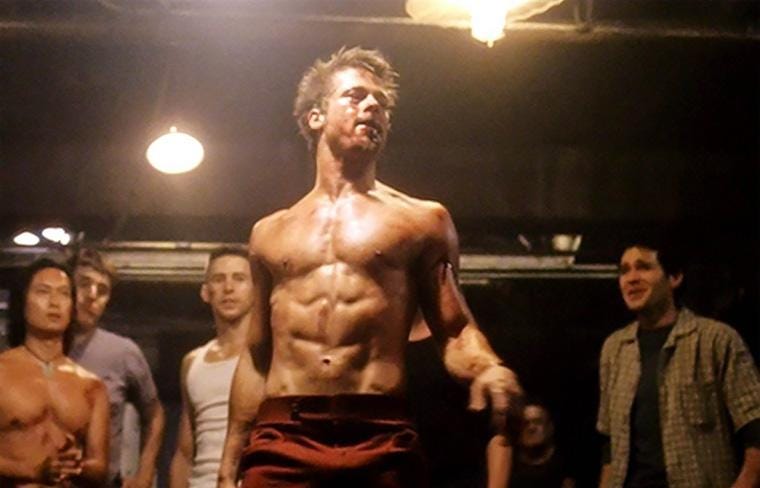
There is another reason Tyler works: he is beautiful. Brad Pitt’s Tyler is charismatic, funny, sexual, confident, fearless, and alive. He looks like freedom.
That matters because our most dangerous illusions rarely arrive looking dangerous. They often arrive wearing the face of something we desperately want. Tyler does not say, “Give me your agency.” He says, in effect, “I will give it back to you.” He does not announce that belonging will eventually become obedience. He offers brotherhood, purpose, strength, and freedom.
The hook is rarely ugly. Our most dangerous illusions often arrive wearing the face of our unmet longing. Tyler is beautiful because surrender has to look like freedom before we will choose it.
Once I saw that, Fight Club stopped looking like a movie only about angry men. It started looking like a warning about how human beings become recruitable.
Indefinite Instability Makes Us Easier to Recruit
Indefinite instability eventually wears us down. Trust erodes. Agency erodes. Our ability to tolerate uncertainty erodes. We become more emotionally locked up and more vulnerable to someone who promises to make the confusion stop.
At the individual level, that vulnerability can make certainty intoxicating. Someone tells us they know what is happening, who is responsible, who the enemy is, and how to make us strong again.
This is where indefinite instability meets demagoguery.
Demagogues do not create all of the fear they exploit. They arrive where fear, humiliation, uncertainty, and lost agency have already prepared the ground. Once there, they have every incentive to keep that ground unsettled.
There is always another emergency, another enemy, another betrayal, another reason to remain afraid, another reason only the in-group can protect you. Not every crisis is manufactured and not every disruption is intentional. But a population that stays frightened, distracted, and emotionally activated is easier to organize around grievance and certainty.
Indefinite instability becomes fuel. While our attention is fixed on the next fight, our aperture narrows. We have less capacity to notice what else is changing around us: institutions, rules, budgets, rights, public assets, relationships, and the architecture underneath everyday life.
Carl Sagan once warned that if people lose the ability to ask skeptical questions and interrogate authority, they become
“up for grabs for the next charlatan, political or religious.”
That feels especially important in a period of indefinite instability, because agency is not only about what we do. It is also about what we believe, what we fear, and who we allow to organize our attention.
This is also where indefinite instability connects to something I have called Extractionocracy. Systems built around extraction do not have to create every crisis. They benefit when people are frightened, divided, distracted, and too emotionally activated to see clearly where power, attention, and value are moving.
But before we look for Tyler in a politician, an algorithm, or a system, Fight Club asks a more uncomfortable question.
Who Is Your Tyler?
It is easy to see someone else’s Tyler: a politician, a movement, a media personality, an ideology, an algorithm, a conspiracy theory, a strongman. It is harder to ask who is mine.
What promise becomes especially attractive to me when I feel powerless? What part of me wants the world divided cleanly into good people and bad people? What part wants somebody to tell me exactly what is happening? What part would gladly exchange uncertainty for certainty?
More importantly, what part of me becomes recruitable when I am frightened, grieving, humiliated, exhausted, or desperate to feel powerful again?
That may be the deeper point of Fight Club. The narrator does not ultimately defeat Tyler by winning a better argument with him. He sees him. He realizes Tyler is not simply an outside force acting on him. Tyler is part of him.
Once Tyler becomes visible, choice becomes possible.
Where Is the Repair?
This is where I think AMP can be helpful right now, not because a movie session can solve the instability around us, and certainly not because the answer is to stop caring, stop resisting injustice, or simply calm down. The question is whether we can remain engaged without allowing fear, anger, or helplessness to reorganize who we are.
Can I protect what matters without becoming consumed by domination
Can I remain strong without becoming hard?
Can I retain agency without needing to control everything?
Can I grieve without needing to destroy something?
Can I remain discerning without demanding certainty?
That suggests a different kind of strength: protection without domination, strength without hardness, agency without control, grief without destruction, discernment without certainty. None of those asks us to choose one side of ourselves and suppress the other. They ask us to find balance.
And perhaps balance becomes the beacon to repair when everything around us is pulling toward extremes.
The Fight Club AMP session asks us to work directly with some of these grooves: the need to prove strength through resistance and control, the belief that conflict is the only way change happens, the idea that anger gives us power, and the belief that without the fight, nothing moves. It then creates room for peace as strength, awareness over reaction, collaboration over conflict, compassion without passivity, and balance without surrender.
This AMP Session, Fight Club, Is for You If:
You feel more reactive, angry, or on edge than you used to, or exhausted by the sense that the ground never stops moving.
You find yourself constantly checking the news, podcasts, or social media for the next crisis or the next thing someone is doing that threatens what you care about.
You find yourself craving certainty, control, or someone who will finally take charge.
You notice that conflict can sometimes make you feel more powerful, alive, or clear.
You want to stay engaged with what is happening without letting fear, anger, or grievance reorganize who you are.
There is a difference between staying informed and staying on alert. When we are constantly scanning for the next crisis, the next outrage, or the next threat, we can become emotionally tethered to the very instability we are trying to understand.
You do not need perfect pitch to hear when something is badly out of tune. Maybe what we need right now is enough internal space to hear the difference between fear and knowing, certainty and clarity, anger and strength, belonging and surrender, a leader and a Tyler.
When the world keeps pulling us toward extremes, balance may be how we find the signal again. The goal is not to become passive or detached from what is happening around us. It is to remain human enough to choose our response rather than have it chosen for us.
Don’t let what is happening turn you into the very thing that is hurting you. This is not a prescription for how to fix America. It may simply be one way not to lose yourself while America moves through this.
Why the Intention Session Matters
In AMP, the Intention Session is used once as a bridge. It asks the mind and body to allow resonance changes to process only in the person’s own timing, with grace and ease.
The point is not to force an immediate breakthrough or tell you what conclusion to reach. It is to let the movie, the statements, and your own reactions work together over time.
You only need to complete the Intention Session once. If you have already done it with another AMP film, it carries over.
Step One: The Intention Session
Speak these aloud:
I allow the changes in my own timing and only integrate what I am ready for.
I have faith that I will receive the benefits I desire.
I am patient with myself as I make these changes.
I let go of feeling I am too busy to take the time for this.
I let go of needing to understand how AMP works and allow myself to receive what is right for me.
Then engage three simple modalities:
Nod your head yes.
Drink some water.
Take several slow, rhythmic breaths through your nose.
Then watch Fight Club all the way through.
As you watch, notice what stirs around anger, numbness, masculinity, belonging, control, certainty, rebellion, aggression, power, and the need to feel alive again. Pay attention to Tyler not only as a character, but as a possible reflection of what becomes attractive when we feel powerless, disconnected, or unable to influence what happens next.
You do not need to analyze the movie or agree with every statement. Simply notice what feels familiar, what creates resistance, what pulls you toward the fight, and what allows you to see your own reactions from a wider vantage point.
A Few Statements From the Fight Club Session
These are only a few examples from a much larger Fight Club session containing hundreds of statements. Some may feel very familiar and others may not feel like you at all. That’s normal.
Don’t use one statement to decide whether the session applies to you. Just notice what lands, what doesn’t, and keep going.
These statements move from anger, aggression, fear, and the need for control toward a different kind of strength:
I let go of believing I have to be aggressive as a man to get ahead or be a winner.
I let go of believing that if I am not aggressive and manly, my power has been stripped from me.
I let go of believing I need to fight other people so I can feel again.
I let go of believing anger and violence are the only answers when I feel powerless.
I let go of believing I would rather blow up the whole system than adapt and change.
I let go of motivating myself or others through fear.
I let go of becoming hypersensitive, easily wounded, or seeing disagreement as an attack.
I allow myself to remain emotionally connected to others even when I am angry, hurt, frustrated, or disappointed.
I allow balanced resolutions to create peace rather than believing another fight will finally end the fighting.
I allow strength, awareness, compassion, and balance to guide how I respond.
About David
David Barnes is the co-creator of the Alignment Movie Process (AMP), a framework that uses film to help people recognize the emotional beliefs and patterns shaping their lives. His work explores emotional maturity, human sovereignty, AI, and how we might build systems that serve human life rather than simply becoming more powerful.
He writes about the patterns beneath our individual and collective choices, and what becomes possible when we move beyond reactivity toward greater awareness, responsibility and integrated wisdom.
To learn more about the Alignment Movie Process and explore how it works, visit AMP EXP.