


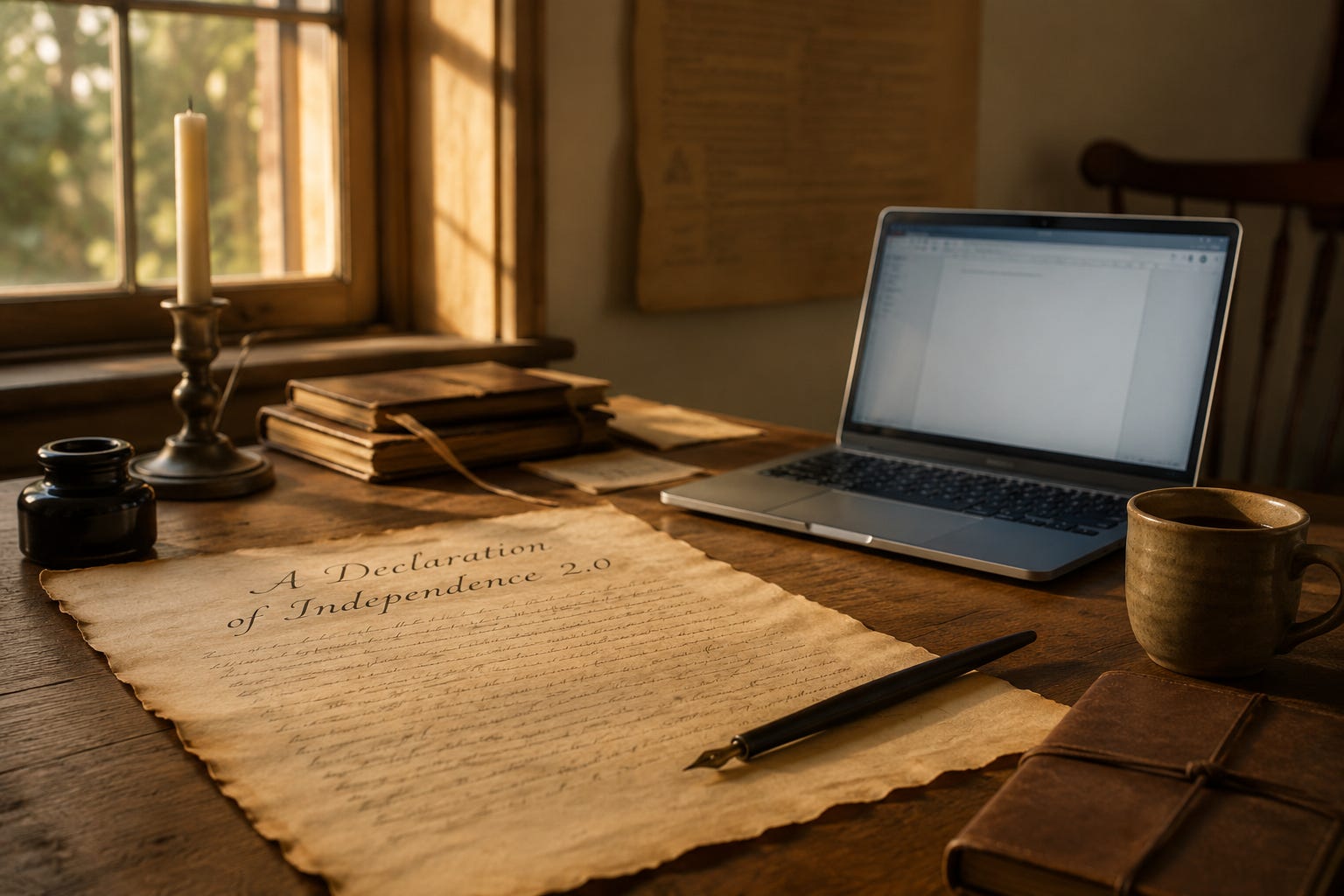
In this post: I explore why the age of AI may be another revolutionary period, why fear alone is not enough to guide it, and why America’s 250th anniversary may be asking for a Declaration of Independence 2.0. Using the AMP lens, the HBO miniseries John Adams, and the idea of spherical thinking, I consider how AI can help us see more of history’s patterns, ask whether compassion is in the model, and begin imagining regenerative systems for the next 250 years.
I was watching a documentary on Thomas Jefferson when something clicked. The revolutionary period was not only about politics. It was about a people beginning to understand that the world they had inherited no longer fit the future trying to emerge. The old structure still had power. The new one was not yet formed. In that gap, people had to decide whether they were going to keep waiting for permission or declare something larger into being.
That is where we are again.
We are entering another revolutionary period, but most of us are not calling it a revolution. We call it innovation, disruption, artificial intelligence, the future of work, productivity, automation, or progress. Underneath all that language, the question is as large as it was in 1776: who or what will shape human life?
In 1776, the question was whether people could live without a king. In 2026, the question is whether people can remain sovereign in a world where intelligence itself can be owned, scaled, automated, monetized, and aimed at them. That is not hyperbole. It is the moment in front of us. Once we understand that, we can remember something else: we are not merely spectators. We have a say in what this next revolution becomes.
Fear Is Not Enough
This week Lura and I were at our neighborhood park with Cosmo, when Gucci, the puppy Cosmo has a serious crush on, showed up with Omar and his family. As dog-park conversations sometimes do, Omar and I wandered from dogs into life, technology, and artificial intelligence.

Omar had picked up that I had a strong point of view about AI, so he asked what I thought about the Pope’s recent writing on artificial intelligence. What came out of my mouth surprised even me. I said, respectfully, that it already felt a step behind the moment.
Not because the concerns are wrong. They are real. The risks are real. The fear is understandable. I admire any leader willing to say that technology must serve human dignity rather than reduce people to data, labor, consumers, or problems to be managed. That warning matters, and the Vatican’s recent writing on AI is part of a serious moral conversation that needs to happen.
But warning is not the same as vision.
Right now, much of the AI conversation is being pulled between fear on one side and commercial acceleration on the other. Both are powerful. Neither is enough. If fear is the only moral language we bring to AI, we may miss the possibility of shaping it toward something more humane. If profit is the only design language we bring to AI, we may build the next extraction system before most people understand what happened.
The fear is valid, but fear cannot be the architect. Fear can warn us, slow us down, and keep us from walking blindly into danger. But fear cannot design the next 250 years. For that, we need something larger: compassion, courage, imagination, human sovereignty, and regenerative systems that serve life.
We are not thinking big enough yet.
Spherical Thinking and the Compassion Test
This is where AI may be able to help us if we learn to use it differently. Most of us are still learning to use AI as a faster assistant: write this, summarize that, make a list, draft an email, find a pattern. Those uses are helpful, but they may not be the deeper opportunity.
AI can also help us practice a wider way of seeing. In my language, it can help us think more spherically. Most of us see from our own branch of the tree, shaped by our life experience, history, fears, hopes, family, culture, education, and body. AI can help us look from more of the tree at once, including history’s branch.
That matters because history is not only a record of what happened. It is full of patterns waiting to be revealed: the decisions that did not work, the voices that were ignored, the grievances that were never resolved, and the programming that keeps repeating until someone finally sees it clearly enough to change it.
Historian Jon Meacham often reminds audiences that
“History may not repeat itself, but it rhymes.”
That is another way of saying patterns return. They come back in new clothing, with new language, tools, and justifications. The deeper groove can keep running until we become mature enough to hear the rhyme and choose a different song.
Spherical thinking asks who is missing from the room. It asks what history has already taught us. It asks who benefits, who carries the cost, what future is being created, and whether the design serves life.
But there is an important test.
If compassion is not in the model, the model is not whole. And if it is not whole, it will not be sustainable or regenerative for generations.
A system can be efficient, profitable, scalable, predictive, and technically brilliant. But if it does not ask who is harmed, who is unseen, who is burdened, who is excluded, and what kind of future it is creating, then it may still be lower-branch intelligence. It may be clever. It may be powerful. But we have bigger thinking to do.
That may be one of the most important questions we can bring to AI, business, government, healthcare, education, media, and technology now: is compassion in the model?
Why This AMP Session Now?
This is also why the AMP Session I am working with this week feels so timely. John Adams: Part II, Independence is based on the second episode of HBO’s award-winning 2008 miniseries John Adams, one of my favorite series.
At the time this AMP Session was created, I could not have known I would later be writing about a Declaration of Independence 2.0 in the middle of an AI revolution, while America was approaching the 250th anniversary of the original Declaration. But that is often how AMP works for me. The session appears before I fully understand why it belongs.
This one carries the exact pattern now in front of us: independence, freedom, intensity, masculine overreach, women’s wisdom, compromise, reconciliation, fear, courage, and the possibility of a nation reaching a new set point. It includes the recognition that men become imbalanced when women are excluded from strategic meetings affecting the future. It also points toward the possibility that when men and women work in partnership, obstacles can be overcome and more peaceful outcomes can be discovered.
That matters because a Declaration of Independence 2.0 cannot be built from the same imbalance that limited the first one. Abigail Adams warned her husband to:
“Remember the ladies.”
That was not only a plea for inclusion. It was a warning about what happens when power designs the future without partnership baked into the operating system.
When partnership is baked in, spherical outcomes become more visible. Compassion is not added later as a softening gesture. It is present in the structure from the beginning.
The Original Room Was Too Small
The Declaration of Independence remains one of the most powerful documents in human history. Its language still carries force because it named something profound: human beings are not born to live under unchecked power.
But the room in which it was created was too small. Women were not fully included. Enslaved people were not free. Native peoples were not honored as sovereign peoples. Future generations were not at the table. The natural world was not understood as a living system upon which all freedom depends.
Those limitations are playing out today. We can see it everywhere. The patterns got bigger. Now they are becoming unsustainable.
That does not make the original Declaration worthless. It makes it unfinished. The first Declaration opened a door that its own age could not fully walk through. The next Declaration must widen the room.
A Wider Convention
The original Declaration was shaped by the people who were in the room. A Declaration of Independence 2.0 must also be shaped by those who were left out of the room, those harmed by the room, those not yet born, and those forms of life that cannot enter a room at all.
This is where AI can help us practice something new. Not by pretending AI has wisdom by itself. It does not. Not by pretending we can literally know exactly what Jefferson, Franklin, Adams, Abigail, enslaved people, Native peoples, future generations, or the living Earth would say. But AI does have access to an unprecedented body of history, testimony, scholarship, grief, warning, imagination, grievance, and hope in real time. In that sense, it can help us hear voices and patterns that have been written, recorded, preserved, ignored, buried, or waiting to be heard.
That does not make AI the conscience. The moral responsibility remains human. But the tool can help us see wider. It can help us ask better questions. It can help us notice what one person, one group, one nation, or one generation might miss from its own branch of the tree.
That may be one of the most important ways to work with AI now. Not merely to move faster, but to see more of the whole before we act.
Why This Declaration Must Be for Humanity
At first, I thought of this as a new Declaration for America’s 250th anniversary. That still matters. America’s anniversary is the doorway. But the more I followed the thread, the more obvious it became that this cannot only be about the United States. We are too interconnected now.
Sue-Anne likes to remind me of something her father, Doug MacGregor, used to say:
“When America sneezes, Aussies get the flu.”
It was his clever way of saying how deeply the United States is tied to the rest of the world. Today, that interconnection is even more obvious.
Artificial intelligence does not stop at national borders. Data extraction does not stop at national borders. Climate systems do not stop at national borders. Supply chains, labor systems, financial systems, media systems, migration, disease, food, war, and communication all reveal the same truth: humanity is already interconnected, whether we mature enough to admit it or not.
The failure to recognize that interconnection keeps us on the lower branches of the tree. So this Declaration must be inclusive of humanity. Not because nations no longer matter. They do. Not because local communities no longer matter. They matter more than ever. But because the next revolution is happening at a scale that requires a wider vision of human sovereignty, human dignity, and shared responsibility.
When America descends into fear, confusion, extraction, or lower-branch thinking, the effects ripple outward. But the reverse may also be true. When America elevates, remembers its deeper promise, and begins designing with more maturity, compassion, and responsibility, that can ripple outward too.
Independence From What?
The first Declaration announced independence from a distant crown. This one must ask a different question: what must humanity declare independence from now?
My answer is not commerce, technology, business, government, or artificial intelligence. Each of those can be organized in ways that serve life. The problem is extraction.
More specifically, it is the pattern I have called Extractionocracy: systems organized around harvesting people’s attention, labor, health, data, fear, debt, confusion, creativity, votes, purchases, and hope while convincing us this is simply how life works.
Extractionocracy keeps people stressed, divided, sick, lonely, distracted, reactive, and easier to manage. It turns human beings into data points, consumers, labor units, political targets, and problems to be managed. It also turns attention into inventory, fear into a market, and sickness into recurring revenue.
This applies to commerce too. If our way of exchanging goods, services, labor, data, attention, and value remains built on extraction, AI will not magically make the system humane. It may simply make extraction faster, smoother, more personalized, and harder to see. That is why the model matters. Regenerative change does not have to begin everywhere to become real, but it does have to begin somewhere.
Now AI may become the most powerful tool ever built for either intensifying that pattern or helping us finally see our way out of it.
Toward a Declaration of Independence 2.0
That is why I believe we need a Declaration of Independence 2.0. Not as nostalgia. Not as a political stunt. Not as a replacement for the original. As an upgrade for a revolutionary moment.
A Declaration of Independence 2.0 would begin with a simple truth: human sovereignty is self-evident. It is not granted by markets, machines, governments, institutions, platforms, algorithms, or empires.
We forgot.
And when people forget their sovereignty, systems are more than willing to organize life for them.
This new Declaration would name the grievances of our time: attention extraction, data extraction, modern slavery, ecological harm, algorithmic influence, fear-based politics, sickness markets, economic pressure, loneliness, disconnection, and the emotional consequences of living inside systems that keep people overwhelmed and divided.
It would also declare a future. For the next 250 years, intelligence must serve wisdom. Commerce must serve human life in a way that is sustainable for the whole living system. Technology must serve dignity. Government must serve the governed. Communities must restore belonging. Freedom must mature into responsibility for one another, for future generations, and for the living Earth.
That is the larger vision.
In the next post, I want to ask what a Declaration of Independence 2.0 might actually declare.
A Small Beginning
This began with Thomas Jefferson on a screen, the John Adams: Part II, Independence AMP Session arriving at the right time, a dog walk with Lura and Cosmo, and a park conversation with Omar that started with concern about AI and ended somewhere better: with the possibility that we can still help shape this revolution toward human evolution.
The fear is real. The risks are real. But so is the possibility. We do not have to wait passively for governments, corporations, platforms, or experts to decide what this revolution becomes. We can begin by remembering that human sovereignty is self-evident. We can begin by asking whether compassion is in the model. We can begin by using AI not only to move faster, but to see wider.
And maybe that is how another kind of revolution begins: not with a king to overthrow, but with a future to declare.
About the AMP Session
The AMP Session connected to this post is John Adams: Part II, Independence, based on Part II: Independence (1775–1776) from HBO’s 2008 miniseries John Adams. The session explores independence, masculine intensity, women’s wisdom, compromise, reconciliation, freedom, courage, and the possibility of a nation reaching a new set point.
That is why it felt timely for this post. A Declaration of Independence 2.0 cannot be built from the same imbalance that limited the first one. This session helps illuminate the pattern underneath the work: what happens when strategy, law, power, and the future are shaped without enough feminine wisdom, partnership, caution, compassion, and whole-system awareness.
Why the Intention Session Matters
In AMP, the Intention Session is used once as a bridge. It asks the mind and body to allow resonance changes to process only on the person’s own timing, with grace and ease. The point is not to force an immediate breakthrough, but to let the film, statements, and reflection work together over time.
The process is simple:
Step One: The Intention Session
You only need to do this once before watching Moneyball. If you have already completed an Intention Session with another AMP film, it carries over.
Speak these aloud:
1. I allow the changes in my own timing and only integrate what I am ready for.
2. I have faith that I will receive the benefits I desire.
3. I am patient with myself as I make these changes.
4. I let go of feeling I am too busy to take the time for this.
5. I let go of needing to understand how AMP works and allow myself to receive what is right for me.
Then engage three simple modalities:
1. Nod your head yes.
2. Drink some water.
3. Take several slow, rhythmic breaths through your nose.
Then watch John Adams: Part II, Independence all the way through.
Let Go / Allow Statements
Selected Let Go / Allow statements for John Adams: Part II, Independence may be shared in a future post as this Declaration of Independence 2.0 series develops.
About David
David Barnes is the co-creator of the Alignment Movie Process (AMP), a framework that uses film to help people recognize the emotional beliefs and patterns shaping their lives. His work explores emotional maturity, human sovereignty, AI, and how we might build systems that serve human life rather than simply becoming more powerful.
He writes about the patterns beneath our individual and collective choices, and what becomes possible when we move beyond reactivity toward greater awareness, responsibility and integrated wisdom.
To learn more about the Alignment Movie Process and explore how it works, visit AMP EXP.
Source Notes
The Vatican released Antiqua et Nova in January 2025, a note on the relationship between artificial intelligence and human intelligence.
Abigail Adams’s “remember the ladies” letter to John Adams was written in March 1776 and is held in the Adams Family Papers at the Massachusetts Historical Society.
John Adams: Part II, Independence refers to Part II: Independence (1775–1776) from HBO’s 2008 miniseries John Adams.
The phrase that history may not repeat itself but often rhymes is commonly attributed to Mark Twain, though the attribution is uncertain. Historian Jon Meacham often uses the idea to describe recurring patterns in American history.