


This week’s AMP Session is The Legend of 1900 (1998). AMP—the Alignment Movie Process—is the framework Sue-Anne MacGregor and I created to help people recognize the emotional beliefs and patterns shaping their lives, using film as a mirror.
The film tells the story of a baby abandoned aboard an ocean liner on the first day of 1900. The crew raises him, and he never sets foot on land. They call him 1900.
He becomes an extraordinary pianist. The ship gives him a home, a family, work and a place for his brilliance. Thousands of passengers move through his life as the ship travels between Europe and America. He studies their faces, senses what they carry and turns it into music.
He is always moving, but he never really leaves.
That may be one of the quieter traps in human life. We can move constantly inside the same political party, religion, profession, family identity or familiar way of understanding the world while remaining inside the structure that tells us what is possible. The scenery changes, but the boundaries remain.
The ship is not an obviously bad place. It carries 1900, protects him and allows his gifts to develop. Within the eighty-eight keys of a piano, he creates what feels like an infinite world.
Then life asks him to consider something larger.
The Edge of the Ship
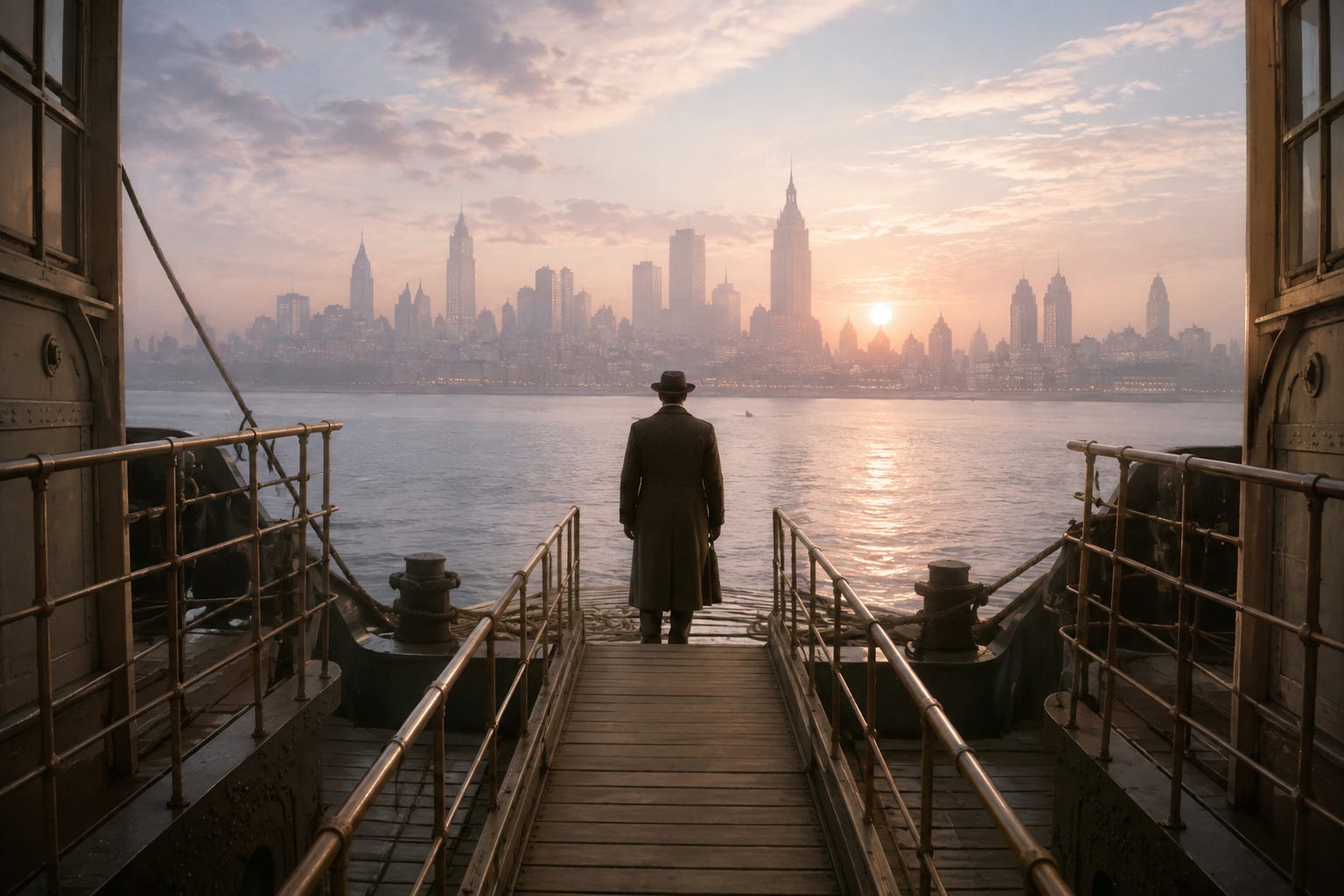
At one point, 1900 decides to leave. He walks down the gangway, looks toward the city and stops.
A piano has eighty-eight keys. He understands those limits, and within them he can create almost anything. The city is different. It seems to offer an infinite number of streets, choices and possible lives, with no visible edge telling him where the whole thing ends.
He turns around and goes back to the ship. I understand that fear. I think most of us do.
We all have ships that help organize our lives. A political party may tell us who stands for what is good. A religion may give us language for God, morality and belonging. A profession may tell us what success looks like and where our abilities fit. A family story may tell us who we are and what people like us are supposed to do.
From inside them, these ships can feel less like one way of seeing the world and more like the S.S. Truth. We may not realize how much they determine what we notice, whom we trust and which possibilities we dismiss before we have really considered them.
When Loyalty Decides What We Can See
In After Me, Then You, I wrote that families edit the story to preserve attachment. We remember enough truth to recognize the person, but not always enough to disturb the love or belonging we still need. What gets left out does not disappear. It continues in the roles people carry and the choices they make.
The same thing can happen inside a church, company or political party. Once a structure helps tell us who we are, questioning it can feel like betrayal.
That may be why we so easily see a harmful pattern when the other side benefits and explain it away when our own side does. Attachment may have already decided what we are willing to notice.
What Happened to Me
Nearly twenty years ago, I could feel that many of the structures I trusted were under strain. I did not know exactly what was coming, and I certainly did not have a roadmap. But I sensed that the political, economic, spiritual and technological changes ahead would require a larger view than the one I had inherited.
I eventually walked away from my religion, my political party and some of the identities that had once told me who I was and where the good people stood.
I did not leave because those structures had given me nothing. They had carried me a long way. Catholicism helped form my spiritual life. My political identity gave me a way to think about responsibility, community and the country. There are still parts of those traditions I respect and sometimes miss.
But they were no longer giving me enough room to understand what I was seeing.
I needed to explore other branches of what I have come to call the Sequoia tree—my image for the many vantage points from which human beings experience the same immense life. I did not do that so I could become right about everyone I had left behind. I needed to see more clearly and begin discerning what contribution I might make to the turbulence I felt coming.
That became part of why I dedicated my life to AMP. I wanted to help other people find their own journey toward the heart and perhaps, from that wider place, discover the contribution that was uniquely theirs to make. Not my answer for them or a new party, religion or belief system. Their own next step.
An Off-Ramp, Not a Roadmap
A film gives us some distance. We watch someone else cling to certainty, hide from change, grasp for control or repeat a familiar choice. Then we may recognize something of ourselves. The story becomes a mirror with breathing room.
AMP does not tell someone which party to join, which church to leave, which relationship to end or what new life to build. It is not a roadmap. It is more like an off-ramp: a place to slow down and notice what may be happening beneath the argument.
Is fear presenting itself as discernment? Am I protecting something sacred, or the structure that once helped me understand it? Is the structure still serving the journey, or do I simply have no idea who I would be without it?
AMP does not force an answer. It creates more room to find one in your own timing, with grace and ease.
You May Not Need to Leave
My journey required me to leave some structures. That is not the prescribed AMP outcome.
I have coached people from many walks of faith: Jewish, Catholic, evangelical, Hindu, agnostic, atheist and others. From what I observed, they did not abandon their traditions because of AMP. More often, their relationship to the tradition widened.
For some, faith became stronger or more personal. Others recognized problems in a particular church, leader or community. Some became less fearful of questions and more able to separate the heart of their faith from the structure carrying it.
The point is not departure. The point is becoming free enough to see what the moment actually requires.
The Cost of Waiting Too Long
In The Legend of 1900, the world changes whether 1900 is ready or not. The ocean liner becomes obsolete and is scheduled for destruction. His decision to remain aboard does not preserve his choices. It gradually narrows them.
That may be the warning inside the film.
The political, ethical, spiritual, economic and technological conditions around us are changing quickly. Old answers may no longer be sufficient for the problems in front of us. If we cannot examine the structures that shaped us, we may become less able to recognize the remedies, collaborators and contributions the moment requires.
Seeing the pattern is the first step. It is not the whole journey, but without it we can continue moving back and forth across the same ocean, believing we are exploring because the scenery changes.
I have seen this on a more personal scale with people I have coached. Some became consumed by whether another person would return, commit, respond or finally understand them. Their minds replayed conversations and searched for the one action that might force certainty.
AMP did not tell them to stop caring, and not everyone experienced the same outcome. But some began catching the rumination sooner. Their attention returned to friendships, work, music, travel and parts of life that had been pushed aside. The external circumstances did not necessarily change. Their relationship to them did.
The old emotional groove was no longer the only available groove.
AI and the View Beyond Our Current Branch
Artificial intelligence is one of the thresholds before us. Many people look at it and conclude that it does not belong in the world they want to preserve. The concerns are real: AI could concentrate power, invade privacy, displace work, reinforce bias, manipulate vulnerable people and make Extractionocracy—the transfer of benefit to those with power while others carry the human, financial or environmental cost—far more efficient.
But refusing to engage will not stop its development. It may simply leave the work of shaping it to those most interested in speed, control and profit. My own use of AI has helped me understand a different possibility. Sometimes I share an experience because I am trying to discover what it means. Sometimes I want it remembered so future work reflects the life I have actually lived. Other times, I want another vantage point capable of holding several strands at once and asking whether there is something I cannot see from where I currently stand.
I bring the life and remain responsible for the judgment. AI may help widen the view.
What a Wider View Makes Possible
This journey has not given me many hard, set-in-stone truths. Most things have become more complicated, not less. I see fewer spotless heroes and fewer people who can be explained entirely by their worst actions. I have become less interested in winning every argument and more interested in what might help us live together without denying what has happened.
A wider view does not require us to abandon discernment or accountability. It gives us more room to recognize the fear, loyalty, grief, ambition, contradiction and longing moving through other people—and through us.
Compassion becomes the unexpected fragrance of a widened life. It may also make us more useful. When another person is no longer simply Them, we may hear a remedy from an unexpected source, work with someone outside our usual group or contribute without demanding that everyone first agree with our entire worldview.
That was part of what I hoped AMP could do: help people make their own journey toward the heart and become more available to the changes facing all of us.
Life Is Immense
For all the uncertainty this journey has opened, one truth has become harder for me to deny: life is immense—far larger and harder to comprehend than the structures we build to explain it.
In The Legend of 1900, one character describes seeing the ocean for the first time:
“It’s like a big scream, telling you that life is immense.”
After nearly twenty years of this work, that comes close to one of the few truths I am willing to hold tightly. Life is more immense than our political party, religion, profession, inherited identity or the branch from which we currently see the world. There is more to discover about one another, ourselves and the contribution we may still be capable of making.
You do not always have to leave the ship to expand your life, but you do have to stop believing the ship is all there is. Sometimes it can be repaired, widened or redirected. Sometimes we have to step beyond it. AMP does not hand us a roadmap or decide where we should land. It offers an off-ramp from fear and rigidity—a chance to look again, cross the threshold on our own terms and discover, with greater compassion, what contribution this immense and changing world may be asking us to make.
This AMP Session Is for You If…
You sense that a belief, institution or identity that once carried you may no longer give you enough room to see clearly.
You feel caught between loyalty to what formed you and curiosity about what may exist beyond it.
You are facing a change but keep waiting until you can see exactly how everything will work out.
You want to examine your political, spiritual or personal assumptions without being told what conclusion you should reach.
You feel called to contribute to the changes around us but suspect fear, certainty or an old emotional groove may be narrowing what you can imagine.
AMP Session Note
Film: The Legend of 1900
Pattern: Fear of change, attachment to familiar structures, difficulty imagining a life beyond what we already know and the belief that we must see the entire path before taking the next step.
This session surfaced because the pattern in the film matches something I see in many of us now. The world is changing, but structures that once helped us understand it can become the very things that prevent us from seeing what is emerging.
1900 is not lacking intelligence, talent or sensitivity. Within the world he knows, he is extraordinary. What stops him is what he cannot see. The world beyond the ship feels too large, uncertain and without boundaries.
The session is not designed to tell anyone whether to stay, leave, repair or redirect the structure carrying them. It helps loosen the fear and rigidity that can make the familiar seem like the only possible world.
Why the Intention Session Matters
In AMP, the Intention Session is used once as a bridge. It asks the mind and body to allow resonance changes to process only in the person’s own timing, with grace and ease. The point is not to force an immediate breakthrough, but to let the film, statements and reflection work together over time.
Step One: The Intention Session
You only need to do this once before watching The Legend of 1900. If you have already completed an Intention Session with another AMP film, it carries over.
Speak these aloud:
I allow the changes in my own timing and only integrate what I am ready for.
I have faith that I will receive the benefits I desire.
I am patient with myself as I make these changes.
I let go of feeling I am too busy to take the time for this.
I let go of needing to understand how AMP works and allow myself to receive what is right for me.
Then engage three simple modalities:
Nod your head yes.
Drink some water.
Take several slow, rhythmic breaths through your nose.
Then watch The Legend of 1900 all the way through.
A Few Statements From the Session
Let Go
I let go of believing I have to see how this works out before I take the next leap.
I let go of allowing what I cannot see to stop me from moving forward.
I let go of hiding from people who come to help me because I am afraid of change.
I let go of clinging to my old ways because I believe I am unable to change.
I let go of believing it is too late for me to start a new way of living.
Allow
I allow myself to see opportunity and not hesitate to take it.
I allow myself to hear people out so fear no longer has a say in my decision.
I allow myself the capacity for adaptive change.
I allow myself to rise above circumstances and courageously face the unknown.
I allow life to be immense and understand it this way.
About David
David Barnes is the co-creator of the Alignment Movie Process (AMP), a framework that uses film to help people recognize the emotional beliefs and patterns shaping their lives. His work explores emotional maturity, human sovereignty, AI, and how we might build systems that serve human life rather than simply becoming more powerful.
He writes about the patterns beneath our individual and collective choices, and what becomes possible when we move beyond reactivity toward greater awareness, responsibility and integrated wisdom.
To learn more about the Alignment Movie Process and explore how it works, visit AMP EXP.