


Mark Cuban Changed the Altitude
I pay attention when Mark Cuban talks about healthcare because he seems able to hold more of its complexity in his head than most people. Drug pricing, PBMs, insurance, doctors, employers, incentives, access. He has spent years digging into how the pieces interact instead of pretending healthcare is one simple problem.
This week he started on X by making the case that AI won’t replace the human part of practicing medicine. A doctor sees things, touches a patient, knows context, talks to other doctors, exercises judgment and responds when something unexpected happens.
A few hours later, he widened the question. AI probably will replace many things doctors currently spend their time doing, he wrote, because so much of their work is what he called healthcare “administrivia.” Instead of asking whether AI can replace doctors practicing medicine, he asked whether AI could replace PBMs, ASOs and other middlemen surrounding them.
He hadn’t abandoned his first point. He had changed the altitude from which he was looking at the problem.
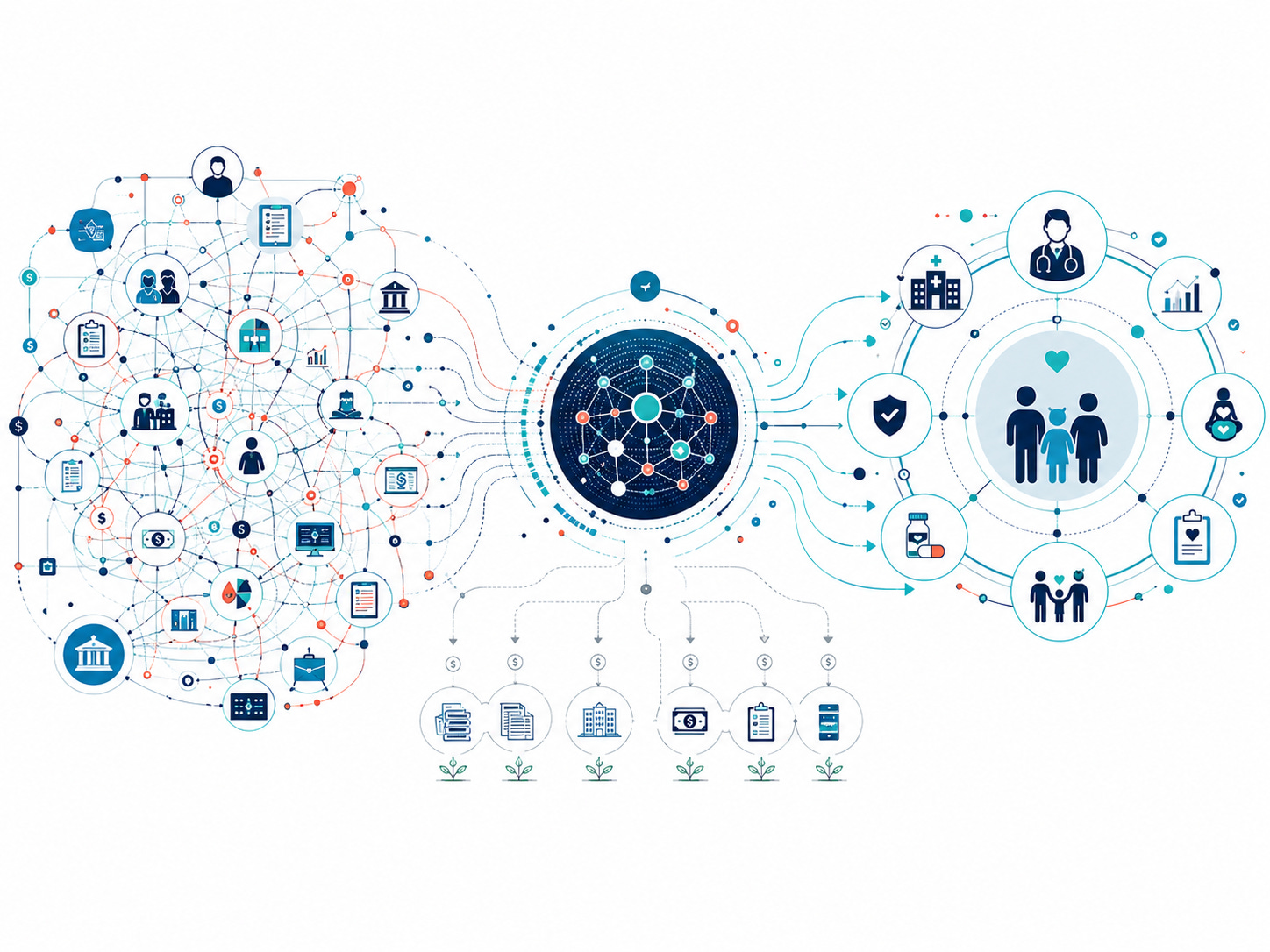
That caught my attention because Cuban is already unusually good at seeing healthcare as a system. But even Mark Cuban has only one human brain, and healthcare may have become too complicated for any one human being to see whole.
We Are Surrounded by Intractable Problems
Healthcare is only one example.
Debt, war, energy, water, food, housing, political division, healthcare. We are surrounded by enormous human problems that smart people have worked on for decades and still can’t seem to move.
Some have become intractable. Not because nobody cares or nobody is smart enough, but because they have become so interconnected, entrenched and full of competing interests that changing one thing moves five others. Industries form around the current architecture. Political identities attach themselves to particular solutions. Capital gets invested. Jobs depend on it. Eventually the system begins defending itself.
Most of our conversation about AI still starts with tasks. What job can it do? Who can it replace? How much faster can it make something we already do?
I think we need to think much bigger.
What if one of AI’s greatest uses is helping humans work on problems that have become too large for humans to hold alone?
We Get Used to Strange Things
My daughter currently doesn’t have health insurance. She recently went to an urgent care clinic and paid the retail price for her visit while she was there. Then she went to a specialist and did the same thing.
A couple of weeks later, both doctors sent her additional bills. When she asked why, she was told the offices hadn’t anticipated all of the billing codes when she paid, essentially the same process they use with patients who have insurance.
Think about how strange that is. She asked what the service cost, paid what she was told it cost, received the service and later discovered that the price wasn’t actually the price.
We have lived inside healthcare like this for so long that some of its strangest features barely register anymore. That is part of what makes an intractable system so hard to change. Eventually the architecture starts feeling like reality.
What Elysium Helps Us See
I created an AMP session around the movie Elysium in 2013.
The movie imagines an Earth where astonishing medical technology already exists. The wealthy live on Elysium, a pristine habitat orbiting above Earth, where medical machines can cure illnesses and repair serious injuries.
Max, a factory worker on Earth, is exposed to lethal radiation. At first his problem is personal: how does he get to Elysium so he can be cured?
But as the movie unfolds, the question gets bigger. Why does he have to break into another world to receive healthcare that already exists?
It is the architecture surrounding access to it.
My original AMP session begins with individual fear and survival, but quickly widens into wealth, poverty, workers, immigration and healthcare access. Later it moves directly into the political and economic structures surrounding healthcare and the search for something more inclusive and affordable.
That movement is why I use movies in AMP.
AMP isn’t an “ism” or a philosophy somebody has to accept. It is simply a tool that can give us enough distance from our familiar position to see a problem from another vantage point. Sometimes it helps us get out of our own emotional groove. Sometimes it helps us notice an assumption, relationship or possible branch that wasn’t visible from where we were standing.
AMP helps open the aperture. AI may help us hold what comes into view.
Spherical Thinking for an Intractable System
I don’t know what the right American healthcare system looks like.
Single payer may solve some problems and create others. Eliminating PBMs may help dramatically and expose another weak point somewhere else. Employer-based models solve some things and create their own distortions.
That’s precisely why I want AI at the table.
Give AI the current system. Give it Medicare, Medicaid, the VA, single-payer systems, private systems, direct primary care, employer experiments, wellness models, drug economics, hospital economics, demographics, outcomes and costs.
Then don’t ask it for the answer.
Ask it to build twenty plausible architectures and stress-test them against one another. Show us what breaks, who loses, where capital fights back, and where prevention genuinely saves money rather than merely sounding good in theory.
Then widen the time horizon. Show us what each path looks like in five years, twenty-five years and three generations. Let AI help us trace consequences across cost, health, access, incentives, labor, capital and public trust.
Then put humans in the loop to make the judgments AI cannot make for us. We still have to decide what tradeoffs are acceptable, what outcomes matter most, and what kind of society we actually want.
That is what I mean by Spherical Thinking for an Intractable System.
The human brings judgment, experience, values and empathy. AI helps us see more of the whole.
What If We Retired the Capital?
There is another problem hiding inside almost every major transition.
Capital doesn’t like to die.
Years ago, while thinking about the transition from old energy systems to cleaner ones, I wondered why we assumed the owners of an obsolete coal plant would simply accept losing the capital they had invested in it.
What if, once a better replacement was operating, part of the transition strategy was simply to buy the old plant out?
We’ve actually done versions of this before. In 2004, Congress ended the old tobacco quota and price-support system and created a ten-year transition program for quota holders and producers. The payments ran from 2005 through 2014. USDA described the program as a “tobacco buy-out” designed to help people tied to the old system transition to a free market.
The government didn’t simply end the old arrangement and expect everyone economically tied to it to absorb the loss. It designed a transition.
We retire people. Why not retire capital?
The same question applies to healthcare. If we eventually identify a better architecture, enormous amounts of money will still be invested in the old one. Companies, investors, employees and communities may have perfectly rational reasons to resist its disappearance.
So what would a capital retirement strategy look like?
Could some capital be bought out, converted or redirected? Could companies make more money helping build the next system than defending the old one? Could we design incentives that make participation in the transition more attractive than blocking it?
Use the greed instead of pretending self-interest is going away.
That may be the practical question buried inside all of this. We don’t need everyone in the old system to become altruistic. We need to understand the incentives well enough to redirect some of them toward a better outcome.
AI could help us model that transition spherically, not just economically. What happens to patients, doctors, workers, investors, taxpayers, communities and future generations under each path?
Maybe some of our intractable problems remain intractable because we keep asking who should win instead of asking what a good transition would actually require.
That Is a Peace Overture
Peace Overtures was never about sitting under a tree staring at my belly button.
It came from a desire to find peaceful outcomes to problems that otherwise keep producing imbalance, conflict and suffering.
Sometimes those problems are emotional or relational. Sometimes they are inside businesses. Sometimes they are enormous public systems like healthcare.
A capital retirement strategy is literally a peace overture.
Instead of assuming change requires defeating everyone invested in the old model, we could use every form of intelligence available to us to search for paths that reduce resistance, redirect incentives and make something better possible.
Americans are very good at fighting the good fight. Maybe AI can help us get better at designing the good transition.
That is one of the futures of artificial intelligence I want us talking about much more.
Not AI replacing humanity. Not AI making our moral choices. Humans bringing judgment, imagination, experience and values to the table, partnered with an intelligence capable of holding complexity at a scale we simply cannot.
Then asking a much bigger question:
What have we been unable to solve because we could never see enough of the whole?
And once we can see more of it, what peaceful path forward might finally become visible?
This AMP Is for You If…
Consider the Elysium AMP session if:
You are tired of healthcare debates that seem to force everyone into the same familiar political camps.
You sense that some problems remain stuck because we keep trying to solve them from inside the architecture that created them.
You want to notice where fear, scarcity, power, money or the need to win may be narrowing the solutions you can see.
You are interested in what happens when we stop asking only who should win and start asking what a transition that serves more people might require.
You want to strengthen your ability to step outside an old frame and consider solutions that may not fit comfortably inside any existing “ism.”
The Elysium session moves from survival, scarcity and unequal access toward compassion, shared healthcare, creative problem-solving and a wider sense of responsibility for one another.
The essay can only take the idea so far. AMP asks you to experience the pattern rather than only understand it.
Why the Intention Session Matters
In AMP, the Intention Session is used once as a bridge. It asks the mind and body to allow resonance changes to process only in the person’s own timing, with grace and ease.
The point is not to force an immediate breakthrough or tell you what conclusion to reach. It is to let the movie, the statements and your own reactions work together over time.
You only need to complete the Intention Session once. If you have already done it with another AMP film, it carries over. This is the same structure used in last week’s Outlaw King post.
Step One: The Intention Session
Speak these aloud:
I allow the changes in my own timing and only integrate what I am ready for.
I have faith that I will receive the benefits I desire.
I am patient with myself as I make these changes.
I let go of feeling I am too busy to take the time for this.
I let go of needing to understand how AMP works and allow myself to receive what is right for me.
Then engage three simple modalities:
Nod your head yes.
Drink some water.
Take several slow, rhythmic breaths through your nose.
Then watch Elysium all the way through.
As you watch, notice what stirs around healthcare, wealth, scarcity, access, work, power, immigration, survival and who is considered worthy of care. You do not need to analyze the movie or agree with every statement. Simply notice what feels familiar, what creates resistance, and what allows you to see the problem from a wider vantage point.
A Few Statements From the Elysium Session
These are only a few examples from a much larger Elysium session containing hundreds of statements. Some may feel very familiar and others may not feel like you at all. That’s normal.
Don’t use one statement to decide whether the session applies to you. Just notice what lands, what doesn’t, and keep going.
These statements move from patterns of scarcity and exclusion toward possibilities the session asks us to consider:
I let go of believing poor people are less important than rich people.
I let go of believing workers are disposable.
I let go of believing there is not enough healthcare or abundance to share.
I let go of believing fear and division are the only ways to protect what we have.
I desire to find creative and practical ways of helping others.
I never forget where I came from and have compassion for all of humanity.
I allow all people to receive the healthcare they need.
I stop thinking small.
I open my mind and heart to solutions that serve more of the whole.
I look for win-win outcomes that allow people and systems to flourish together.
About David
David Barnes is the co-creator of the Alignment Movie Process (AMP), a framework that uses film to help people recognize the emotional beliefs and patterns shaping their lives. His work explores emotional maturity, human sovereignty, AI, and how we might build systems that serve human life rather than simply becoming more powerful.
He writes about the patterns beneath our individual and collective choices, and what becomes possible when we move beyond reactivity toward greater awareness, responsibility and integrated wisdom.
To learn more about the Alignment Movie Process and explore how it works, visit AMP EXP.