



Peace Overtures Today is a weekly newsletter dedicated to guiding individuals on their personal quest for inner peace. Each week, I share a movie that helped me discover balance. It’s a process of awareness and healing that leads to sparks of joy. I’m sincerely grateful to have you here with me.
One of the most satisfying experiences of creating Alignment Movie Process (AMP) sessions is the personal transformation I undergo. The more I learn about my imperfections and alter my mindset, the easier it becomes for me to navigate life with balance. Of course, it also brings me great joy to share what I've learned with others.
This week's featured AMP film completely transformed how I interact with those in my life. It has helped me reduce conflicts, minimize drama, and gain a deeper understanding of myself, enabling better connections and collaborations with others. It has also brought me a sense of peace.
An empowering outcome of changing the resonance of patterns within oneself is that you are no longer a match for the previously limiting ways. Consequently, the people you're connected with also have the opportunity to change. This may result in them no longer engaging in behaviors that used to bother you. However, it's important to acknowledge that sometimes they may not be willing to change and will exit your life. Why? Because your frequencies no longer match.
The life-changing AMP session I want to share with you is Doubt (2008), a session I've been working on for several years. It's a powerful and insightful movie that I believe will positively impact how you interact with others.
Doubt is set in St. Nicholas Catholic Elementary School, where Sister Aloysius (Meryl Streep) holds a leading role. When Sister James (Amy Adams) shares her concerns about Father Flynn (Philip Seymour Hoffman) possibly showing excessive attention to the school's only black student, Donald Miller (Joseph Foster), Sister Aloysius takes it upon herself to probe into Flynn's actions. Doubt takes us on a gripping rollercoaster of drama and intrigue, vividly portraying the common dysfunctions that can occur in our relationships.
The Focus Of This AMP Session: The Drama Triangle
A significant aspect of this AMP session involves resonance statements related to the Dr. Stephen Karpman’s Drama Triangle. The movie Doubt brilliantly portrays this drama and dysfunction in action. Before you watch the film, I recommend reading Cait Flanders' description of the Drama Triangle. She explains it so clearly that I thought it would be beneficial to include it here. If you enjoy her writing style, check out her Substack page - she's easy to like!

The Drama Triangle
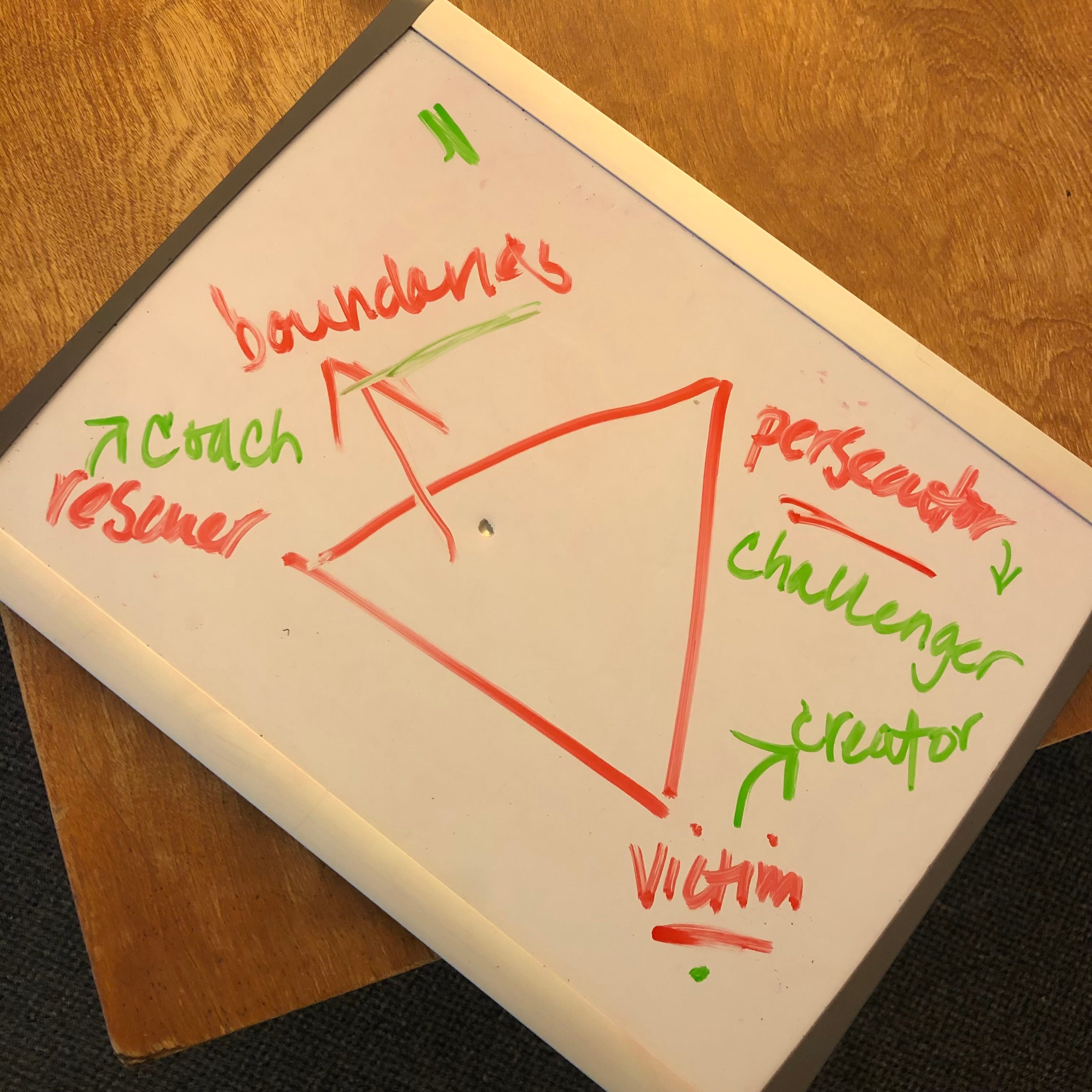
The drama triangle is a model of human interaction that was proposed by Dr. Stephen Karpman in 1968, and has since become a tool that is often used in therapy (specifically transactional analysis). It is a framework that helps us understand the dysfunctional roles we might play out during conflict and why we adopt those roles (there are reasons we do this and even feel we benefit from it). It’s also a framework to show why we remain stuck in that conflict. Warning: once you understand the drama triangle, you’ll start seeing it everywhere! Not just in your own conflicts, but in any you witness/hear about too.
The framework is fairly simple. If you are, or someone you know is, stuck in a particular conflict, the people involved are probably playing out one of three roles in the drama triangle:
The Persecutor: someone who is trying to stay in control of the situation, largely by pointing fingers and placing blame and even threatening others. They might show up as controlling, critical, angry, superior, even authoritarian. To avoid feeling any amount of fear or guilt or shame or responsibility, they will make the situation “your fault.”
The Victim: not an actual victim, but someone who is acting as though they are one. They might express feeling hurt, wronged, helpless, powerless, even oppressed. And they might seem like they want to be rescued/helped, but they really just want to blame someone for their problems (the persecutor), then have someone else validate their feelings and say “poor you” (the rescuer).
The Rescuer: someone who is often outside of the drama itself, but who feels worthy and good about themselves by helping others, and will happily enter a conflict to do so. Sometimes rescuers step in on their own, and sometimes they are called in by the victim. Either way, their role is to say the “poor you,” and then “I can help/let me help you.”
As you might be able to see, everyone gets something out of these roles. That doesn’t mean it’s healthy (it can actually be really damaging), but there’s a reason they adopt each role—otherwise, they wouldn’t play them out. You can also swaproles in different conflicts, or even within the same conflict, which is all part of the drama triangle! But if you want to get out of the drama triangle, either by resolving the conflict or just removing yourself from it, you need to set boundaries (the red arrow in the diagram above) and transform into a different role instead:
The Persecutor needs to become a Challenger: where instead of being aggressive or defensive toward others, you become confident and assertive in your communication. This includes asking questions rather than placing blame, and taking responsibility for your role in the situation. You literally challenge everyone—including yourself—to navigate getting out of the drama.
The Victim needs to become a Creator: where instead of playing out the idea that you are a victim of everything that’s happened/happening, you remember you can make different choices and try to create change in your life. As a creator, you become less focused on the drama or problem itself, and more focused on the solution and desired outcome.
The Rescuer needs to become a Coach/Guide: where instead of swooping in to help (which promotes dependency), you trust everyone can take care of themselves (self-responsibility). As a coach/guide, you stop giving advice, and start encouraging people to feel empowered enough to make different choices for themselves. Then, move on from the conflict and leave them to it.
As you’re watching Doubt, look for who is the persecutor, the victim, and the rescuer. Notice how they change roles depending how the drama is proceeding.
As you digest and integrate the film, take a moment to reflect on where you see this dynamic occurring in your life.
Is there a way you can move into a more empowering role?
Is the situation too challenging, indicating it's time to take a pause and step away?
Is it time to establish new boundaries or as I call them, lines of respect?
This AMP session will help you elevate your awareness and help with the above questions.
I've learned that some dynamics can be too difficult to change. Especially with those who remain firmly rooted in their roles. When the experience becomes too complicated and dysfunctional, I choose to step aside altogether, giving myself the space to discern what I truly want to do.
Since there's a lot to absorb this week, I'll focus only on the Karpman Triangle for now. There's more to explore in this movie, which I intend to discuss in a future post.
If you want to fully experience the resonance benefits of this session, remember to start with The Intention Session first, and then watch the movie in its entirety. This AMP session delves deep, so if you find yourself getting sleepy during the movie, pause and continue another day.
Once you grasp this concept and truly see it, you'll recognize it everywhere. Dysfunction in how we work and play together is a widespread pattern. May this movie assist you in breaking free from it with grace and ease.
David! I'm so happy I've found you. As I huge cinephile, I'm so drawn to your use of movies to demonstrate ones discovery of peace. Having seen Doubt too many times, I was able to follow exactly what you laid out, but I'm planning a rewatch and will have your words guide me. Thanks!
Fascinating stuff! My first reaction to the movie involved alot of anger, but the more I read your post, studied the triangle, and digested what I was seeing, the more the anger started to diapate. I was able to start understanding the various roles from a non-judgmental point of view and better understand where I am in the triangle. Powerful stuff!